From Sunday School classrooms to living-room small groups, the church has always found new ways to bring God’s people together. What began in the 1700s as a movement to teach children the Bible has grown into a worldwide story of discipleship and community. Each generation has reshaped how we gather—sometimes in large classes for learning, sometimes in small circles for sharing life—but always with the same goal: helping people know Christ and walk with Him more closely. The journey from Sunday School to small groups reminds us that while methods change, God’s call to grow in faith and fellowship never does.
Here’s a brief on the history of Sunday School and how we’ve added small groups as a way to know the Bible and Jesus.
Origins of Sunday School
-
Late 1700s (England)
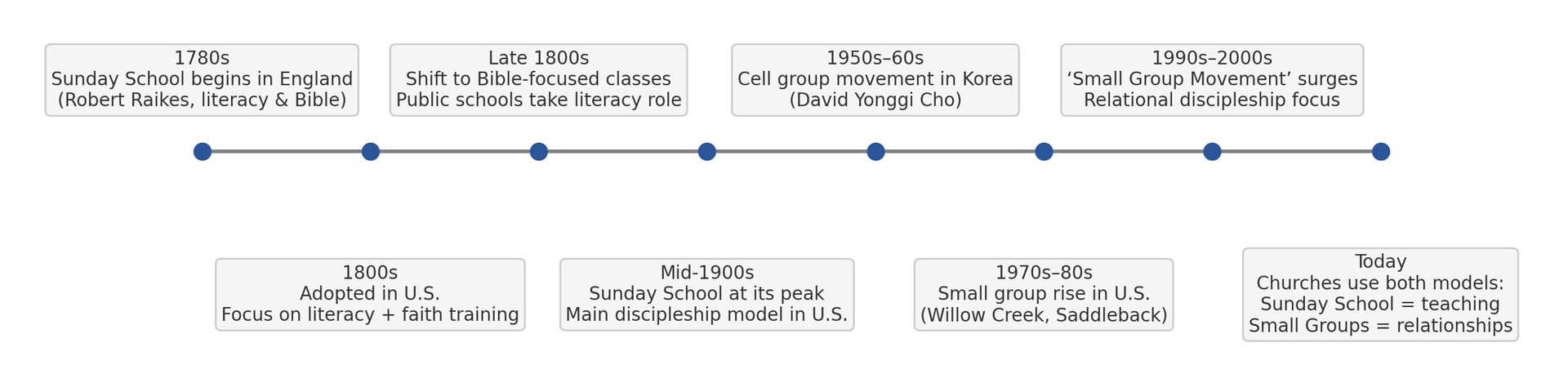
Sunday School began as a social reform movement . In industrial England, children worked six days a week, and Sunday was their only day off. Robert Raikes (1780s) helped pioneer Sunday Schools to teach literacy, Bible lessons, and moral instruction to poor children. -
Early 1800s (U.S. adoption)
The idea spread quickly across the Atlantic. In the U.S., Sunday Schools initially served as both educational programs (reading, writing, catechism) and religious training, especially before public schooling was widespread. -
Late 1800s – 1900s
As public schools took over literacy education, Sunday Schools shifted toward Bible-centered teaching . By the mid-20th century, the “Sunday School hour” became a fixture of almost every Protestant church in America.-
Organized by age or life stage.
-
Emphasized structured curriculum and large group teaching.
-
Often considered the discipleship arm of the church .
-
Decline of Traditional Sunday School
By the 1970s–1990s , several cultural changes affected Sunday School:
-
Families became busier, with sports and activities competing for Sunday mornings.
-
Fewer young adults connected with church through formal classes.
-
The “classroom style” began to feel rigid or institutional.
-
Churches noticed that while Sunday School taught Bible knowledge, it often lacked relational depth and accountability.
This created an opening for a more relational model.
Rise of Small Groups in the U.S.
-
1950s–1960s : The modern “cell group” concept was popularized globally by movements like David Yonggi Cho’s church in Korea , which grew through multiplying home groups.
-
1970s–1980s : U.S. evangelical leaders (e.g., Bill Hybels at Willow Creek, Rick Warren at Saddleback) saw small groups as the best way to foster community, discipleship, and evangelism .
-
1990s–2000s : The “small group movement” surged. Books like Carl George’s Prepare Your Church for the Future and Rick Warren’s Purpose Driven Church framed small groups as essential to church health .
 Sunday School vs. Small Groups Today
-
Some churches kept Sunday School as their main discipleship model.
-
Others shifted entirely to small groups (sometimes called life groups, community groups, or house groups).
-
Many hybrid churches run both:
-
Sunday School for structured teaching.
-
Small Groups for relational discipleship and outreach.
-
Summary
As we look back on the path from Sunday School to small groups, we see the faithfulness of God guiding His church through every season. Each method—whether structured teaching or intimate gatherings—has played a vital role in helping believers grow and communities flourish. The challenge for us today is not to cling to one model over another, but to embrace the heart behind them both: making disciples, building relationships, and reaching the world with the love of Christ. Our calling is to carry that mission forward, creating spaces where God’s Word is taught, His Spirit is experienced, and His people are known and loved. Even more, we can use technology (chat, SMS, email) to help our groups become closer, share the Word and grow in Faith.